Optical Coherence Tomography (OCT)
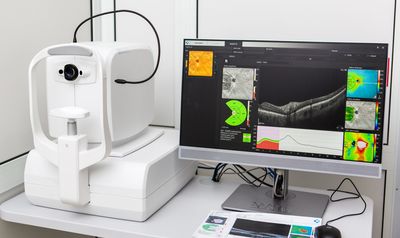
Optical Coherence Tomography (OCT): Advanced Retinal & Optic Nerve Imaging
Modern eye care goes beyond simply determining whether you need glasses; it plays a crucial role in eye disease detection. Many eye diseases can progress silently, often without noticeable symptoms. Early detection of these conditions is vital to help preserve your vision.
At Brown’s Eye Center, we utilize advanced eye imaging technology through Optical Coherence Tomography (OCT). This state-of-the-art imaging method allows us to obtain highly detailed cross-sectional images of the retina and optic nerve. The OCT technology enables our doctors to assess structures beneath the surface of the retina that cannot be visualized through routine examinations.
What Is Optical Coherence Tomography (OCT)?
Optical Coherence Tomography (OCT) is a non-invasive imaging test that employs light waves to generate detailed cross-sectional images of the retina, optic nerve, and other crucial structures within the eye.
Comparable to an ultrasound, OCT utilizes reflected light instead of sound waves to produce extremely high-resolution images.
These detailed images assist your eye doctor in evaluating the health of the retina and optic nerve, tracking changes over time, and facilitating the diagnosis and management of a variety of eye conditions.
What Can an OCT Scan Detect?
OCT provides valuable insights that may assist in evaluating and monitoring numerous eye conditions, including:
- Glaucoma
- Diabetic retinopathy
- Macular degeneration (AMD)
- Macular edema
- Epiretinal membranes
- Vitreomacular traction
- Macular holes
- Retinal swelling
- Central serous chorioretinopathy (CSR)
- Optic nerve disorders
- Other retinal and optic nerve abnormalities
Your OCT findings are interpreted alongside your symptoms, examination results, medical history, and, when necessary, supplemental diagnostic testing. An OCT scan forms an integral part of a comprehensive eye evaluation.
Why Might My Doctor Recommend an OCT?
Your doctor may suggest OCT if you:
- Have glaucoma or are at increased risk for glaucoma
- Have diabetes
- Have macular degeneration
- Experience blurry or distorted vision
- Notice changes in central vision
- Suffer from unexplained vision loss
- Display retinal abnormalities during an examination
- Require monitoring of a previously diagnosed eye condition
OCT may also be periodically performed to monitor changes over time.
Is an OCT Scan Painful?
No, OCT is entirely non-invasive and painless.
There are no injections, no contact is made with the eye during the scan, and no radiation exposure occurs.
Most scans are completed in just a few minutes.
Will My Eyes Need to Be Dilated?
Not necessarily.
Some OCT scans can be conducted without dilation, while others may require it to enhance image quality or facilitate a more thorough retinal examination.
Your doctor will determine the need for dilation based on your specific examination.
How Does OCT Help Detect Glaucoma?
Glaucoma can damage the optic nerve, often well before you notice any changes in vision.
OCT technology allows your doctor to measure the thickness of the retinal nerve fiber layer (RNFL) and other optic nerve structures. These measurements can help identify structural changes associated with glaucoma and provide a baseline for future comparisons.
Given that glaucoma diagnosis relies on multiple clinical findings, OCT results are interpreted alongside your eye pressure, optic nerve examination, visual field testing, corneal thickness measurements, and other clinical data.
How Does OCT Help Evaluate the Retina?
The retina comprises several specialized layers that collaborate to facilitate vision.
OCT generates detailed images of these layers, enabling doctors to assess retinal anatomy and recognize changes that may not be visible during routine examinations.
This technology is particularly essential when evaluating diseases that affect the macula, the central area of the retina responsible for detailed vision.
Can OCT Detect Eye Diseases Before Symptoms Develop?
In certain cases, OCT may identify structural changes even before a patient experiences vision changes. However, no test guarantees the detection of every eye disease at its earliest stage.
Regular comprehensive eye examinations remain crucial, as your doctor integrates OCT findings with your medical history, examination, and other diagnostic tests to evaluate your overall eye health.
How Often Should OCT Be Performed?
The recommended frequency of OCT scans depends on your specific condition and risk factors.
Some patients may require OCT infrequently, while others with glaucoma, diabetic eye disease, macular degeneration, or other retinal issues may benefit from consistent imaging to monitor changes over time.
Your doctor will suggest an imaging schedule tailored to your particular needs.
Why Choose Brown’s Eye Center?
At Brown’s Eye Center, we leverage advanced eye imaging technology, including Optical Coherence Tomography (OCT), to assist in the evaluation and monitoring of retinal disease, glaucoma, and other eye conditions.
Our experienced doctors integrate modern imaging with thorough clinical examinations and personalized care to support patients in making informed decisions regarding their eye health.
We proudly serve patients in Warner Robins, Bonaire, Kathleen, Perry, Centerville, Byron, Fort Valley, Macon, and surrounding communities in Middle Georgia.
Frequently Asked Questions
Is OCT covered by insurance?
Coverage varies based on your insurance policy and the medical necessity of the test. Our team is here to help clarify any questions regarding your benefits.
Does an OCT replace a dilated eye exam?
No, while OCT is a crucial diagnostic tool, it does not substitute a comprehensive eye examination when necessary.
Can OCT detect glaucoma?
OCT can offer valuable information about the optic nerve and the retinal nerve fiber layer. It is one of several tests utilized in the evaluation and monitoring of glaucoma.
Is OCT safe?
Yes, OCT is a non-invasive, painless procedure that uses light instead of radiation.
How long does the test take?
Most OCT scans are completed within just a few minutes.
Related Services
- Comprehensive Eye Exams
- Glaucoma Evaluation & Management
- Diabetic Eye Exams
- Macular Degeneration
- Medical Eye Care
- Emergency Eye Care
Schedule Your Eye Examination
If your doctor has recommended an OCT scan or if you're due for a comprehensive eye examination, reach out to Brown’s Eye Center today. Our knowledgeable doctors use advanced eye imaging technology to assess and monitor the health of your eyes and vision.